Renter Resources · University City · Safety
In 2026 - Is University City Safe for UNC Charlotte Students? A practical safety guide for first-time renters near UNCC
When you're renting your own place for the first time, there are so many things to think about all at once – movers, change of address, furniture, roommates (maybe), keys, parking – the list goes on and on. And unfortunately, nobody hands you a safety briefing. There's no RA (if you are coming from dorms on campus), no card scanner for building entry access, no apartment full of people who all signed into the same system. You are getting your first place – whether it be a room for rent off-campus or a full apartment with you and your friends. SAFETY – is now fully your responsibility. Here's what that means in practice — based on 13 years of managing student housing in University City for Queen City Management Services | UNCC Rooms. (And if you want all of this in one place — costs, leases, neighborhoods, the parent chapter — the free 2026 UNCC Off-Campus Housing Guide is here.)
Is University City safe for UNCC students?
That's a great question and one of the most talked about concerns when discussing housing options for students. The short answer: yes — the numbers say University City is getting safer in 2026, and we'll show you the actual numbers below. But before we jump into them, let's get a good understanding of where and how the stats come to be.
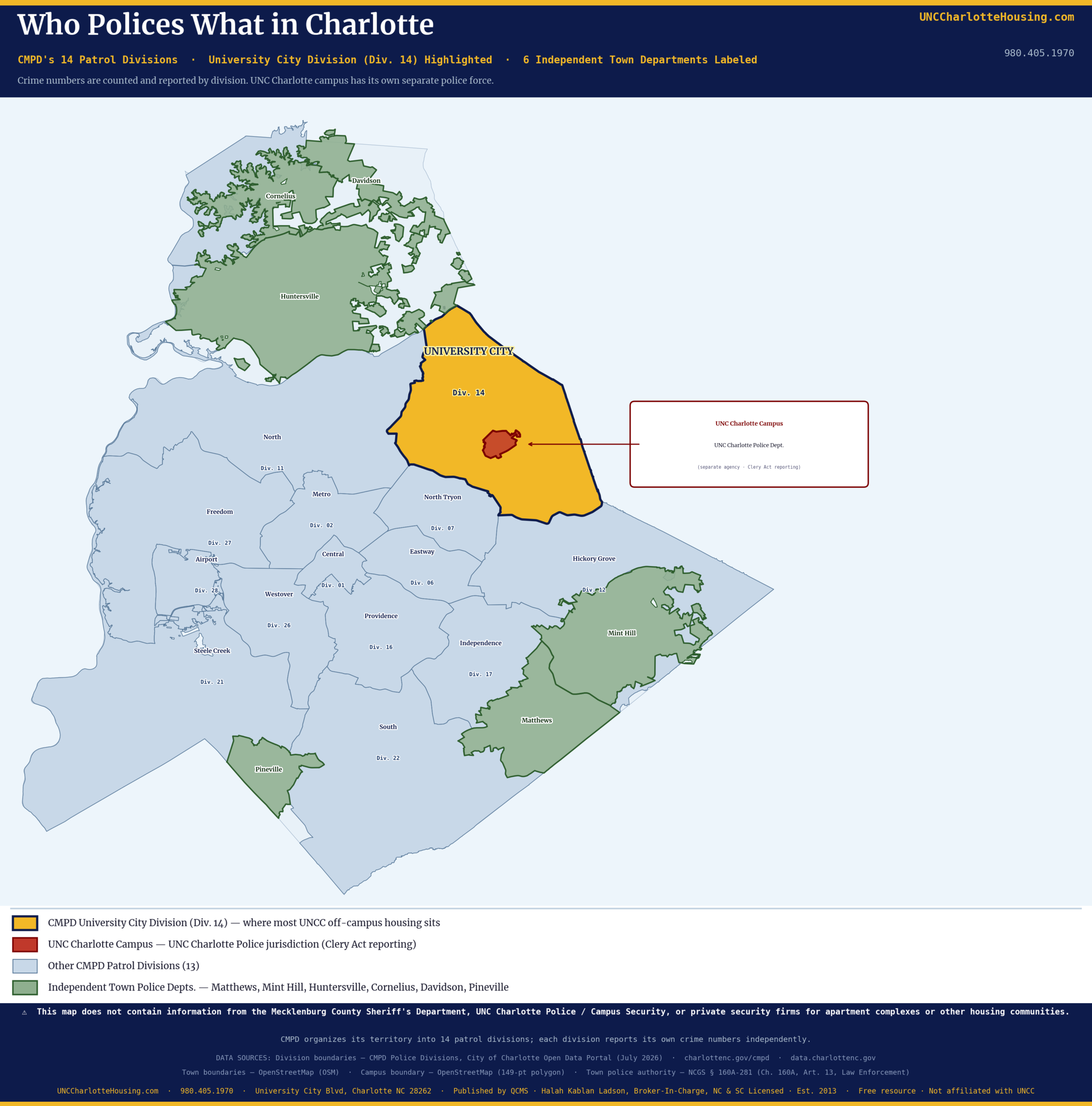
Mecklenburg County and the city of Charlotte itself are comprised of 14 divisions covered by the Charlotte-Mecklenburg Police Department (CMPD). There are six (6) smaller townships that are not included within the CMPD patrol and have their own police departments: Matthews, Mint Hill, Huntersville, Cornelius, Davidson, and Pineville. CMPD is not part of the Mecklenburg County Sheriff's Office (which runs the jail and the courts, not neighborhood patrol), UNC Charlotte Campus Police, or any private security companies hired by housing communities.
See the attached map to get an outline of the CMPD Divisions, and which one covers the University City area of Charlotte (Division No. 14).
How are crime stats actually reported in Charlotte?
So here is an interesting fact most people do not know – each division is responsible for reporting its own statistics. However, individual patrol divisions do not get to decide how they classify or count their crimes. They all feed their raw data into a single centralized system governed by strict federal, state, and departmental rules.
1. The Federal Mandate: FBI NIBRS
Every patrol division classifies crimes according to the National Incident-Based Reporting System (NIBRS) — the FBI's national reporting standard, managed at the state level by the North Carolina State Bureau of Investigation (SBI).
Because they use NIBRS, all divisions must record data identically:
No “Hierarchy Rule”: Under the old summary reporting system, if a suspect robbed a store and assaulted the clerk on the way out, only the most serious offense — the robbery — made the count. Under NIBRS, every offense within a single incident is counted.
52 Standard Offenses: Every division logs incidents using the exact same federal definitions for 52 Group A offense types — from fraud to aggravated assault — ensuring an apples-to-apples comparison across the whole city. (FBI NIBRS; NC State Bureau of Investigation.)
2. Centralized Quality Control
While officers in the Central, University City, or Steele Creek divisions type up the initial police reports, they do not publish their own final stats.
All division reports flow through CMPD's centralized crime analysis staff before publication. Analysts verify that offense classifications match the narrative of each report, remove unfounded cases (false reports), and clean the data — and the state SBI and FBI run their own validation checks before the numbers enter the national system.
3. Standardized Public Dashboards
When a division “reports its own numbers,” it is pulling from the same centralized records system. CMPD's open data portal segments incidents automatically by coordinate location: if an incident occurs 10 feet inside the South Division border, it lands in South Division's data pool — no judgment calls, no borrowing.
4. CompStat (Operational Accountability)
While the reporting rules are identical, the pressure on those numbers is felt division by division. CMPD uses a data-driven management model heavily inspired by CompStat.
Division captains regularly review their numbers with department leadership. If burglaries spike in a division, its captain has to explain what the data shows and how resources — like the division's Crime Reduction Unit — are being redeployed to answer it.
So keep that in mind when you hear the crime stats on the news, the ones on a grading website, and the ones your parents find when they Google as they can all be measuring different areas, counted in different ways.
University City, and all the student-housing communities managed by QCMS (University Terrace, University Terrace North, Colville & Shannon Green) are all located in this single division. For patrol purposes, CMPD splits this particular division into three numbered response areas (3 of the city's 47 response areas).
Two things to know before you read a single stat about University City, Division No.14 - It's big — 46.8 square miles, one of the largest divisions in the city (University City Partners, 2023) — and it includes major shopping corridors, which is why shoplifting ranks among its most common incidents. What matters is understanding the crime that’s relevant to your situation – which, for this article, is housing. Shoplifting stats are not important in reference to how safe it is to walk to your car at night. So keep that in perspective. A division total is NOT your street. It's a big net, and it catches the mall too. (CMPD Police Divisions and CMPD Police Response Areas layers, City of Charlotte Open Data Portal, July 2026.)
The campus itself isn't even in those numbers. UNC Charlotte runs its own police force — a separate agency entirely — and campus incidents are reported under a federal law called the Clery Act, in the Annual Security and Fire Safety Report published every October at police.charlotte.edu/clery-act. And grading sites like CrimeGrade.org? They build estimates from reported data using their own boundaries. Fine as a first look. Never the final word.
The citywide quarterly briefings you see in the news roll all 14 divisions together — but the division-level detail is public, sitting on the city's open data portal at data.charlottenc.gov. Anyone can look it up. I did.
What do the University City Division numbers actually show?
These come straight from the CMPD Incidents dataset, filtered to the University City Division. Not a headline, not a letter grade — the actual counts. (City of Charlotte Open Data Portal, July 2026.)
| Period | Incidents | Change |
|---|---|---|
| Q1 2025 | 3,028 | |
| Q1 2026 | 2,775 | down 8.4% |
| Jan–Jun 2025 | 5,950 | |
| Jan–Jun 2026 | 5,673 | down 4.7% |
| Full year 2024 | 12,103 | |
| Full year 2025 | 11,776 | down 2.7% |
The honest read: University City is improving — down 8.4% in the first quarter of 2026 — but not as fast as Charlotte overall, which fell 23%. I'd rather you know that than only hear the prettier number.
| Category (Jan–Jun) | 2025 | 2026 | Change |
|---|---|---|---|
| Theft from motor vehicle | 762 | 492 | down 35% |
| Motor vehicle theft | 688 | 448 | down 35% |
| Burglary / breaking & entering | 231 | 176 | down 24% |
| Simple assault | 468 | 529 | up 13% |
| All other thefts | 393 | 504 | up 28% |
Car break-ins and stolen vehicles — the two crimes most likely to actually touch a student — fell by more than a third. Assaults ticked up; most are between people who know each other, not strangers. It belongs in the picture anyway. (CMPD Incidents dataset, pulled July 2026. Counts are incident reports and subject to revision.)
With that context, here is the answer. The University City Division's own incident count fell 8.4% in Q1 2026. Citywide, crime dropped 23% compared to Q1 2025 — including an 18% drop in violent crime and a 30% drop in residential burglaries — and University City North earned a B safety grade from CrimeGrade.org as of May 2026, placing it in the top 35% of U.S. neighborhoods. (CMPD Q1 2026 Public Safety Briefing, April 16, 2026; City of Charlotte Open Data Portal, July 2026.)
The honest asterisk, from the same report: homicides rose — 22 in Q1 2026 versus 16 a year earlier. CMPD's chief noted those cases overwhelmingly involve people who know each other, not random street crime. It doesn't change the practical picture for students, but you deserve the whole report, not just the good rows.
The most accurate local data isn't on Reddit. It's the UNC Charlotte Annual Security and Fire Safety Report — published every October at police.charlotte.edu/clery-act under the federal Clery Act. It covers on-campus incidents and the immediately surrounding neighborhood. Read it. It takes twenty minutes.
“Parents ask me every week if University City is safe. I tell them to read the Clery Report and then come walk the property with me at night. Data tells you the trend. A nighttime site visit tells you the specific corner. You need both.” — Halah Kablan Ladson, Broker-In-Charge, Queen City Management Services | UNCC Rooms
What kind of crime should you actually worry about near UNCC?
The thing most likely to affect you near campus is property crime — not violent crime. Larcenies from autos fell 34% citywide in Q1 2026. Vehicle thefts dropped 34% in the same period. Residential burglaries dropped 30%. (CMPD Q1 2026 Public Safety Briefing, April 16, 2026.)
The most common entry point in off-campus housing isn't a broken lock. It's an unlocked one — specifically a ground-floor window or patio door. “Many times, a thief will enter an unlocked residence and find free reign on the bottom floor because all residents are on the second floor.” (Syracuse University Department of Public Safety, 2025.)
| What happens near campus | Why it's preventable |
|---|---|
| Items stolen from unlocked cars | Remove valuables, lock every time, park in lit areas |
| Ground-floor window entry | Lock every window when you leave and when you sleep |
| Tailgating through a secured entry | Don't hold the door — even for someone who looks like a student |
| Package theft | Use an Amazon locker or require a signature |
| Theft on late walks home | Use the LiveSafe virtual escort feature |
One more thing while we're being direct: a gated entry is a feature, not a security system. A gate that closes behind a car that just pulled through is not protecting your unit. Locks, lighting, and re-keying protect your unit.
What habits do you need when you're managing your own space?
- Lock the door every time — including when you're home. Your front door is it now. Lock it when you leave. Lock it when you're upstairs. Lock it when you sleep.
- Close your curtains at night. A window that lets anyone see what you own and whether you're alone is not a small thing. Curtains cost nothing.
- Know your route before you need it. Walk the path from the bus stop, the parking lot, and the campus entrance to your front door during the day. Use the well-lit version at night. The shortcut through a dark cut-through isn't worth it.
- Download LiveSafe before your first week of class. It connects directly to UNC Charlotte Police, lets you share your real-time location with a contact on a late commute, and has a virtual escort feature — a dispatcher stays on the line until you're inside. Free. (UNC Charlotte Police Department, 2026.)
- Tell someone your route. A quick text — “leaving the library, heading home” — to one person. It takes three seconds and someone knows where you are.
- Get renter's insurance. The property owner's policy covers the building. It covers nothing you own. Your laptop, your bike, your clothes — gone in a theft or kitchen fire with no recourse if you don't have your own policy. North Carolina renter's insurance typically runs under $25/month. (NC Department of Insurance, 2025.)
What does a lockout cost near UNCC — and how do you avoid paying it?
Before you ever need it, ask the leasing office what a lockout call costs after hours. Some complexes charge $150 or more to let you back into your own apartment at 2 AM. That's not a scam — it's in your lease. You just didn't read that part.
The fix is simple: keys go with you every time you leave the unit. Mailbox run. Trash. Grabbing something from your car. Keys in hand before the door closes. Get into that habit in week one.
How do roommates change your security?
Most units near UNCC house three or four people, often strangers matched by the leasing office. Your security is only as good as the least careful person in that apartment.
If you're on a by-the-bed individual lease — common near UNCC — your bedroom door needs its own lock. Your roommate's guests are in your space too. If someone leaves the front door unlocked at midnight because they're expecting a friend, that's your problem as much as theirs.
First week, have the conversation. Five minutes. Who locks up at night, what's the rule on guests having a key, does the front door stay locked when people are home. Say it out loud once so everyone's heard it.
What should you check before you sign a lease near UNCC?
There's a full pre-signing safety rundown on our safety page — what to inspect on every tour, the three questions any well-run leasing office answers instantly (lighting, lock re-keying at turnover, after-hours maintenance), and the complete list of numbers to save.
If you only take one thing from it: come back at 9 PM on a Friday before you sign anything. The 2 PM Tuesday tour is the property's best self. Twenty minutes at night tells you more than the tour did.
What is the most expensive parking mistake near UNCC?
Lock your car. Remove valuables. Everyone says that. Here's the part they don't.
Don't hide your laptop under a jacket on the passenger seat — someone just watched you put it there. Put it in your trunk before you arrive at your destination, not after you park. Once you're in the lot, it's too late.
The bigger financial hit near UNCC isn't break-ins — it's towing. Student housing complexes in University City enforce parking hard. No resident decal, wrong spot, visitor parked overnight — your car gets towed before anyone calls you. Tow yard fee plus after-hours retrieval can run $300 or more. First week: find out where visitors park, get your decal on your car, know the overnight rules.
What do parents need to know?
Crime on the CATS Blue Line dropped 69% in Q1 2026 after CMPD and CATS added dedicated security officers across the system. (CMPD Q1 2026 Public Safety Briefing, April 16, 2026.) For students commuting, both campus-area stations serve them well — UNC Charlotte–Main on campus, and JW Clay Blvd by University Place; which one your student uses depends on where they live.
University City has something most college corridors don't — UNC Charlotte runs its own police force and patrols the streets around campus, and University Research Park sits right next door, which means a large, stable corporate and research presence in the immediate area.
Renter's insurance is the one thing almost nobody gets until after they need it. The property owner's policy covers the building — not your student's laptop, bike, or anything else they own. A standard policy in North Carolina typically runs under $25/month. Confirm your student has one before move-in day. (NC Department of Insurance, 2025.)
And save two numbers in your own phone, not just theirs: UNCC Police non-emergency, 704-687-2200, and UNCC CAPS 24/7 crisis line, 704-687-0311.
“I've managed student housing in University City for 13 years. The situations that go wrong are almost never random. They're a broken habit — an unlocked window, a property that doesn't re-key, a student who didn't know who to call. None of those are complicated. They just require asking before you sign.” — Halah Kablan Ladson, Broker-In-Charge, Queen City Management Services · Licensed NC & SC · NC Firm No. C24768 · Est. 2013
Next steps
Sources: CMPD Q1 2026 Public Safety Briefing, April 16, 2026 · charlottenc.gov · UNC Charlotte Annual Security and Fire Safety Report, October 2025 · police.charlotte.edu/clery-act · CrimeGrade.org University City North, May 2026 · Syracuse University Department of Public Safety via Her Campus, August 2025 · NC Department of Insurance 2025 · UNC Charlotte Police Department · UNCC CAPS.
Queen City Management Services · NC Firm No. C24768 · Licensed NC & SC · Halah Kablan Ladson, Broker-In-Charge · NC License No. 272964 · Est. 2013 · Charlotte · Matthews · Huntersville · Concord · Rock Hill · Mecklenburg · Union · Gaston · York County SC · Not affiliated with the University of North Carolina at Charlotte.