Renter Resources · University City · 529 Plans
Can a 529 Plan Pay for Off-Campus Housing Near UNC Charlotte?
UNC Charlotte classes start in less than a month. And many, many students and parents are still searching for housing. They have invested and saved money for their children to attend school using the 529 Education Account and now it is time to use it for dorms. But can it be used in a more flexible way — legally, in a way the IRS explicitly allows? Absolutely — here’s how to use a 529 plan to pay for off-campus housing near UNC Charlotte.
Yes — 529 funds can pay your student’s rent near UNC Charlotte, tax-free, up to the university’s official housing allowance. Federal law treats room and board — including rent for an off-campus apartment in University City — as a qualified 529 expense, as long as the student is enrolled at least half-time and the amount stays within UNC Charlotte’s official cost-of-attendance housing allowance (IRS Publication 970; 26 U.S.C. § 529). For 2026–27, that allowance is roughly $833 per month — and with private rooms near UNC Charlotte renting for $525–$900 per month (QCMS/UNCC Rooms rate sheet, July 2026), a 529 can cover most or all of a student’s rent. This guide covers the rules, the limits, the 12-month-lease trap, and the mistakes that turn tax-free money into a 10% penalty.
QCMS is a real estate firm, not a tax advisory — treat this as general information and confirm your family’s specifics with a CPA or tax attorney.
Does the IRS allow 529 money to pay rent off campus?
Yes — with two conditions. Room and board counts as a qualified higher education expense under IRS Publication 970 when (1) the student is enrolled at least half-time, and (2) the amount claimed does not exceed the room-and-board allowance in the school’s official cost of attendance for the student’s living arrangement. The apartment does not need to be university-affiliated: a standard lease at a University City complex or a rented room in a Colville Road condo qualifies the same way. (IRS Publication 970, 2025 edition; 26 U.S.C. § 529(e)(3)(B).)
What matters is who is enrolled, not who signs the lease. The 529 beneficiary must be the student; the lease can name the student alone or with co-signers.
“Every August we meet parents who have five figures sitting in a 529 plan and assume it can only touch tuition. Room and board is a qualified expense under federal law — that money can pay your student’s rent in University City, and most families never use it.”
— Halah Kablan Ladson, Broker-In-Charge, QCMS · Licensed NC & SC · NC License No. 272964
What is UNC Charlotte’s 529 housing limit for 2026–27?
The ceiling is set by UNC Charlotte, not the IRS. Each year the university publishes a cost of attendance (COA) that includes a housing and food allowance; 529 withdrawals for room and board are tax-free only up to that allowance. UNC Charlotte’s published 2026–27 figures:
| COA line item (2026–27) | Amount | Monthly equivalent (12 mo) |
|---|---|---|
| Housing — on-campus estimate | $10,200/yr | $850 |
| Food — on-campus estimate | $5,662/yr | $472 |
| Housing — off-campus allowance | $10,000/yr | ≈ $833 |
(UNC Charlotte Undergraduate Admissions, Cost of Attendance, 2026–27; off-campus allowance per Niner Central. Confirm your student’s exact allowance in Niner Central — it is set per living arrangement and can change each academic year.)
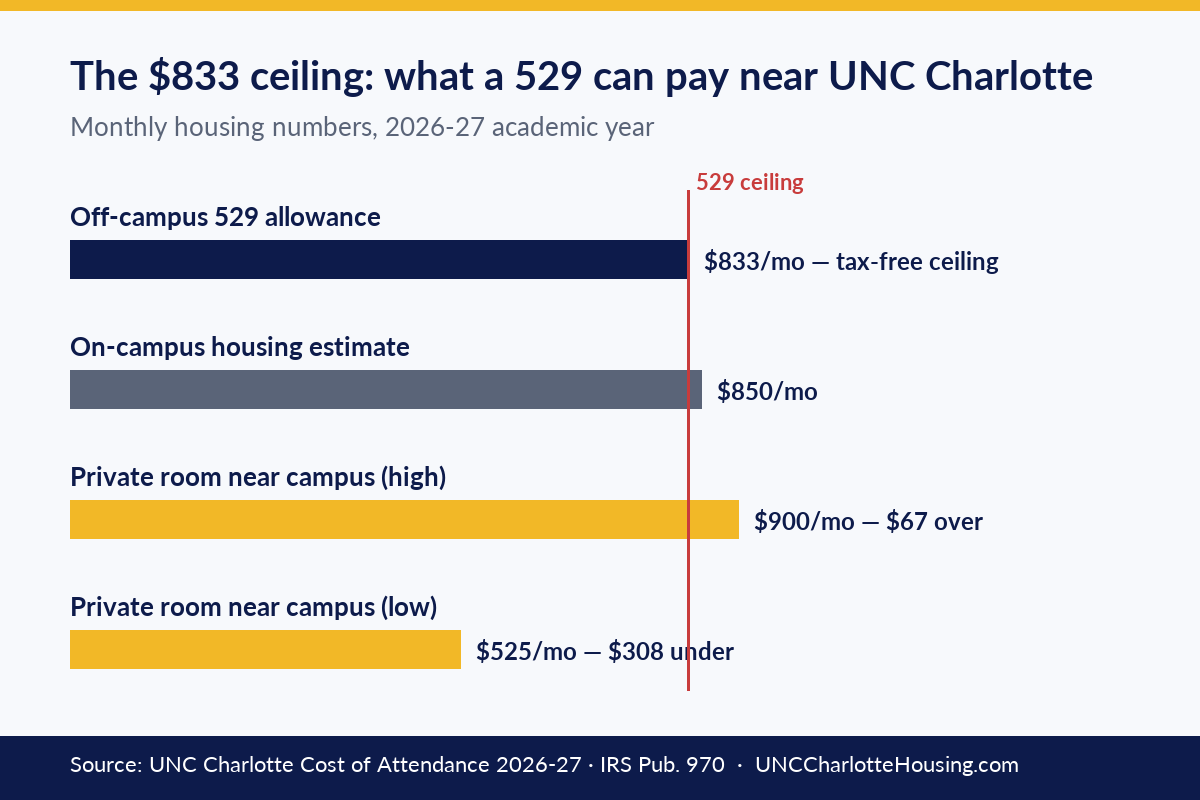
“A $525-a-month private room sits about $300 under the federal ceiling every single month. Families are often surprised the math works better off campus than on.”
— Halah Kablan Ladson, Broker-In-Charge, QCMS · Licensed NC & SC · NC License No. 272964
How do you actually pay rent with a 529?
The mechanics are simpler than most families expect — the discipline is in the documentation. Five steps:
- Confirm the current off-campus allowance in Niner Central (it is set per academic year).
- Verify enrollment status — the student must be enrolled at least half-time during the academic period the rent covers.
- Take the distribution in the same calendar year the rent is paid. A December withdrawal for January rent is the classic mismatch that shows up at tax time (IRS Publication 970).
- Pay the rent — from the 529 to the account owner, then to the landlord, or directly where the plan allows. Keep the trail clean: one account, traceable payments.
- Keep the lease, rent receipts, and enrollment verification together. The IRS does not require receipts to be filed, but Form 1099-Q distributions must be defensible if questioned.
Do groceries and utilities count as 529 expenses?
Generally yes, within the allowances. Utilities that are part of keeping the student housed are treated as part of housing cost, and groceries count toward the food allowance — $5,662 for 2026–27 (UNC Charlotte COA). Two practical notes: keep grocery receipts separate from household items (only food counts), and remember the housing and food allowances are separate ceilings — you cannot shift unused food allowance onto rent that exceeds the housing cap.
Can a 529 pay summer rent on a 12-month lease?
Only if the student is enrolled at least half-time that summer. This is the trap most families near UNC Charlotte hit: standard University City leases run 12 months, but room and board is only a qualified expense for academic periods in which the student meets the half-time enrollment test (IRS Publication 970). A student who goes home for June and July while the lease keeps running generally cannot use 529 funds for those two months of rent.
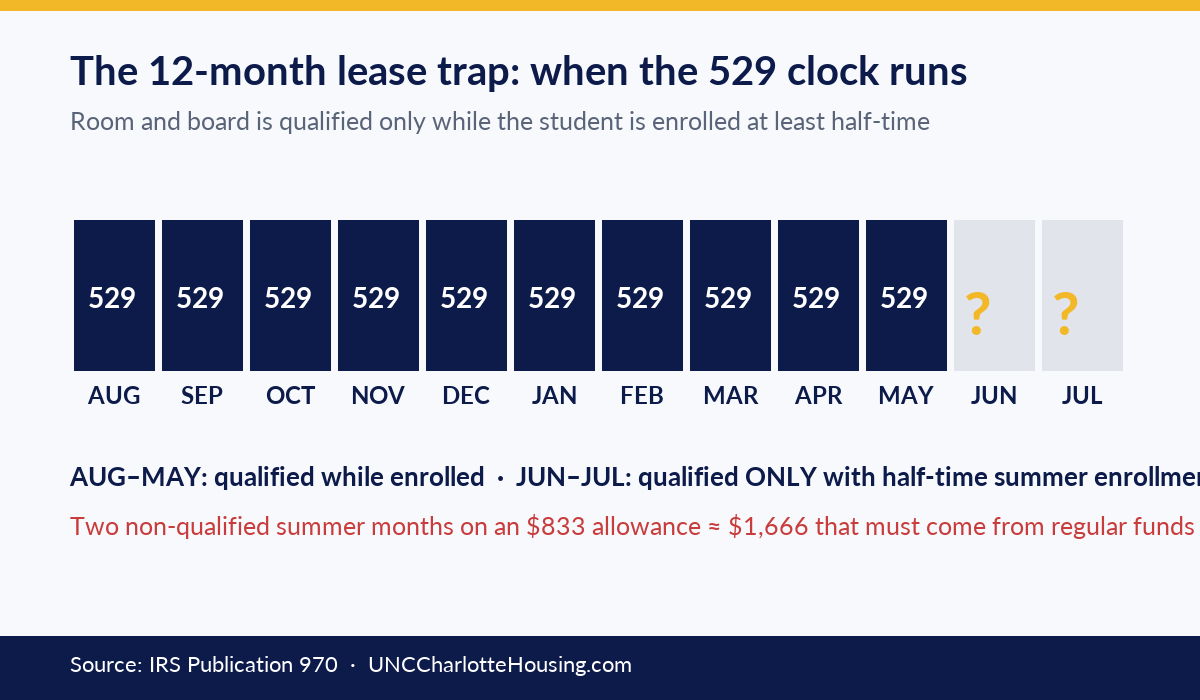
“Twelve-month leases are the standard in University City — nobody tells parents that the 529 clock only runs while the student is enrolled. Two summer months of rent is a $1,600 surprise you can plan around in five minutes.”
— Halah Kablan Ladson, Broker-In-Charge, QCMS · Licensed NC & SC · NC License No. 272964
What mistakes trigger taxes and penalties?
When a 529 withdrawal fails the qualified-expense test, the earnings portion becomes taxable income plus a 10% additional federal tax (IRS Publication 970). The recurring mistakes:
| Mistake | Consequence |
|---|---|
| Withdrawing more than the COA housing allowance | Excess earnings taxed + 10% penalty |
| December withdrawal for January rent (calendar-year mismatch) | Distribution and expense don’t align; earnings portion exposed |
| Paying summer rent while not enrolled half-time | Those months are non-qualified |
| No lease or receipts kept | Distribution indefensible if the IRS asks |
| Counting household supplies as “food” | Only groceries count toward the food allowance |
| Paying the security deposit with 529 funds | A refundable deposit isn’t an expense — it’s your money held in trust. Non-qualified; pay deposits from regular funds |
One North Carolina note: NC’s own 529 (the NC 529 Plan, administered by CFNC) offers no state tax deduction for contributions — the benefit is federal and state tax-free growth on qualified withdrawals (CFNC.org). The housing rules above apply to any state’s 529 plan, not just North Carolina’s.
What if your family wants to buy instead of rent?
Some UNC Charlotte families take the next step: a parent purchases a condo near campus, the student leases it at fair market rent, and 529 distributions pay that rent within the same allowance rules — while the parent builds equity. That strategy has its own mechanics (fair-market rent, a written lease, CPA review) and we’ve covered it separately: see Use Your 529 to Buy a Condo Near UNCC for the structure, and QCMS’s investor-side breakdown for the tax treatment. For most families, though, renting within the allowance is the simpler play — no property, no landlord obligations, same tax-free dollars.
FAQ: 529 plans and off-campus housing at UNC Charlotte
Can 529 money pay rent for an apartment near UNC Charlotte?
Yes. Rent for off-campus housing is a qualified 529 expense when the student is enrolled at least half-time, up to UNC Charlotte’s official cost-of-attendance housing allowance — roughly $833 per month for 2026–27 (IRS Publication 970; UNC Charlotte COA).
Does the apartment have to be affiliated with the university?
No. Any legitimate rental — an apartment complex, a rented room in a private condo, or a house share — qualifies the same way. The limit is the dollar allowance, not the landlord.
Can the 529 pay rent directly to the landlord?
Some plans allow direct payment; most families take the distribution to the account owner or student and pay the landlord normally. Either way, the distribution must match qualified rent paid in the same calendar year, with the lease and receipts kept.
What happens if rent is higher than the allowance?
Nothing punitive — the portion above the allowance simply isn’t qualified. Pay the excess from regular funds and use the 529 only up to the cap.
Is a meal plan required to use 529 funds for food off campus?
No. Groceries count toward the food allowance ($5,662 for 2026–27) with receipts — a meal plan is not required for off-campus students.
Can a 529 pay the security deposit on a lease?
No. A refundable security deposit isn’t a housing expense — it’s money held in trust and returned at move-out, so it fails the qualified-expense test. Pay deposits from regular funds and reserve 529 withdrawals for rent itself.
Sources: IRS Publication 970, Tax Benefits for Education (irs.gov/publications/p970) · 26 U.S.C. § 529 · UNC Charlotte Undergraduate Admissions, Cost of Attendance 2026–27 (admissions.charlotte.edu) · Niner Central, Estimating Costs (ninercentral.charlotte.edu) · QCMS/UNCC Rooms rate sheet, July 2026 · Niner Times housing survey · CFNC, NC 529 Plan (cfnc.org)
This article is general information from a real estate firm, not tax or legal advice. 529 rules are enforced per taxpayer and the university’s allowance figures change annually — confirm your family’s situation with a CPA or tax attorney before withdrawing funds.
UNCCharlotteHousing.com is a free off-campus housing resource for UNC Charlotte students and parents, published by QCMS — serving University City and Charlotte, NC since 2013.